Staff induction checklist. A printable induction checklist for somebody starting in a children's home — the children, the policies that matter on the first night, and what they must not do until they are trained.
This is the paper version. CareOptix does the same job on a phone, with the record filed against the young person or the staff member automatically.
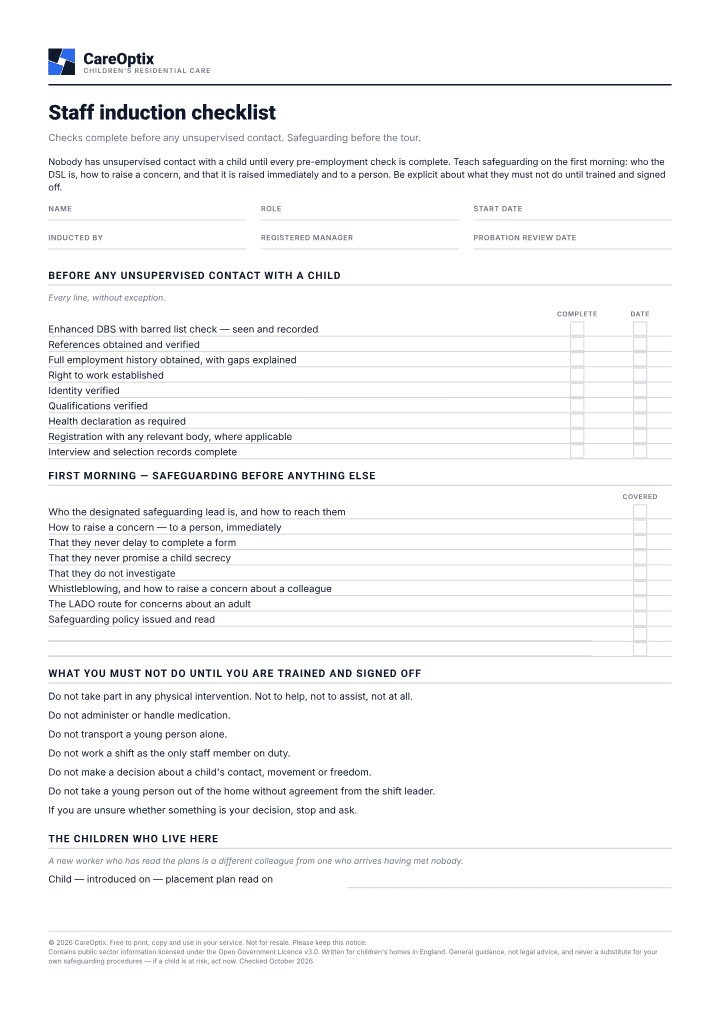
What is on the sheet
- The person, their role, start date and who is inducting them
- Pre-employment checks confirmed complete before any unsupervised contact with children
- The children: who lives here, their plans, and what each needs from the people around them
- Safeguarding first: who the DSL is, how to raise a concern, and that it is raised immediately
- What they must not do until trained and signed off, including any physical intervention
- The home, the shift, recording, and a probation review block with dates
Why this record matters
The first line of this checklist is that pre-employment checks are complete, because everything after it depends on that. Safer recruitment requirements exist precisely because a children's home is a place where an unsuitable adult can do enormous harm, and 'the DBS is in the post' is not a position to start a shift from.
Safeguarding comes before the tour. A new member of staff who knows nothing else should know who the designated safeguarding lead is, how to raise a concern, and that they raise it immediately and to a person rather than into a form. That can be taught in five minutes on the first morning and is the single highest-value thing in any induction.
The 'must not do until trained' list is explicit, and physical intervention is on it. New staff are sometimes drawn into restraint on a difficult shift because nobody told them not to, and a checklist that says plainly they do not take part until they are trained and signed off protects the child and the member of staff.
Knowing the children is what makes somebody useful rather than present. A new worker who has read the placement plans, knows what helps each young person when things are hard, and has been introduced properly is a different colleague from one who arrives on a night shift having met nobody.
Use it with
- Staff supervision recordA printable supervision record — the children, the practice, the person doing the job, and what was actually agreed rather than discussed.
- Safeguarding concern recordA printable record of a safeguarding concern — what was seen or said, what was done about it immediately, and who was told.
- Incident recordA printable incident record — what led up to it, what happened, what the child said afterwards, and what the home is going to do differently.
- Placement plan templateA printable placement plan — how this home will meet this child's needs day to day, written with the child rather than about them.
Read more on this
© 2026 CareOptix. Free to print, copy and use in your service. Not for resale. Please keep this notice.
Contains public sector information licensed under the Open Government Licence v3.0. Written for children's homes in England. General guidance, not legal advice, and never a substitute for your own safeguarding procedures — if a child is at risk, act now. Checked October 2026.