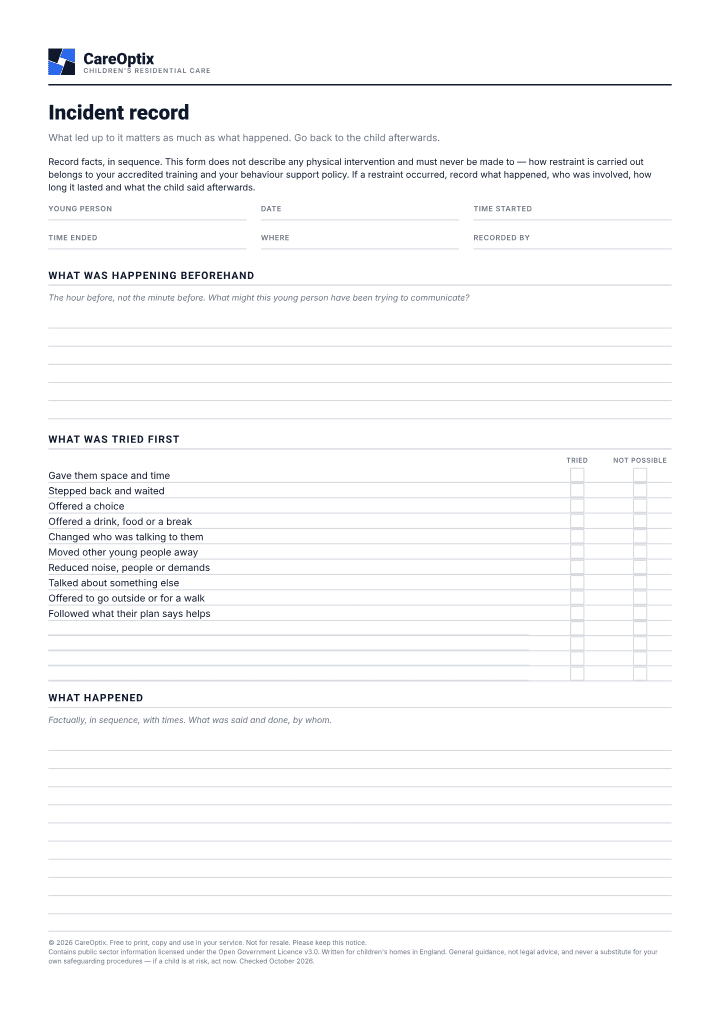
Incident record. A printable incident record — what led up to it, what happened, what the child said afterwards, and what the home is going to do differently.
This records an incident. It does not tell you what to do during one — nothing here describes or endorses any physical intervention, because that belongs to your accredited training provider and your behaviour support policy, and a free form has no business on that subject. Nor does it decide whether an event is notifiable. What CareOptix does is make sure the record is made, reaches the registered manager, and is counted alongside the others.
What is on the sheet
- The child, the date, time, place and who was present
- What was happening beforehand, and what the child may have been communicating
- What staff tried first — space, distraction, talking, offering a choice, stepping back
- What happened, factually and in sequence
- Whether anybody was hurt, what medical attention was given, and what the child said afterwards
- Whether this is a notifiable event, who decided, and the learning with an owner and a date
Why this record matters
Incidents in children's homes are usually the visible end of something that started much earlier, which is why the first substantive section on this form is what was happening beforehand. A record that begins at the point a chair went over has thrown away the half that would prevent the next one.
What was tried first is the section that shapes practice. A home that can show it offered space, a choice and time before anything else is a home with a culture; one whose records jump straight to the incident is telling an inspector something it did not mean to.
This form does not describe any physical intervention, and it must never be made to. If a restraint occurred, what belongs in the record is what happened, who was involved, how long it lasted and what the child said afterwards. How restraint is carried out is a matter for your accredited training provider and your behaviour support policy, and nothing on a form downloaded from a website has any business on that subject.
Talking to the child afterwards is on the form because it is the thing most often skipped on a hard shift and the thing that matters most to the young person. What they said about it, including if they said nothing, belongs in the record — and so does whether anybody has been back since.
Use it with
- Safeguarding concern recordA printable record of a safeguarding concern — what was seen or said, what was done about it immediately, and who was told.
- Daily log and key work recordA printable daily log and key work session record — what happened, what the child said and did, and what it means, written so a child could read it.
- Placement plan templateA printable placement plan — how this home will meet this child's needs day to day, written with the child rather than about them.
- Missing from care recordA printable record for a child missing or away from the home without agreement — what was done, who was told, and what the child said when they came back.
Read more on this
© 2026 CareOptix. Free to print, copy and use in your service. Not for resale. Please keep this notice.
Contains public sector information licensed under the Open Government Licence v3.0. Written for children's homes in England. General guidance, not legal advice, and never a substitute for your own safeguarding procedures — if a child is at risk, act now. Checked October 2026.