Daily log and key work record. A printable daily log and key work session record — what happened, what the child said and did, and what it means, written so a child could read it.
This is the paper version. CareOptix does the same job on a phone, with the record filed against the young person or the staff member automatically.
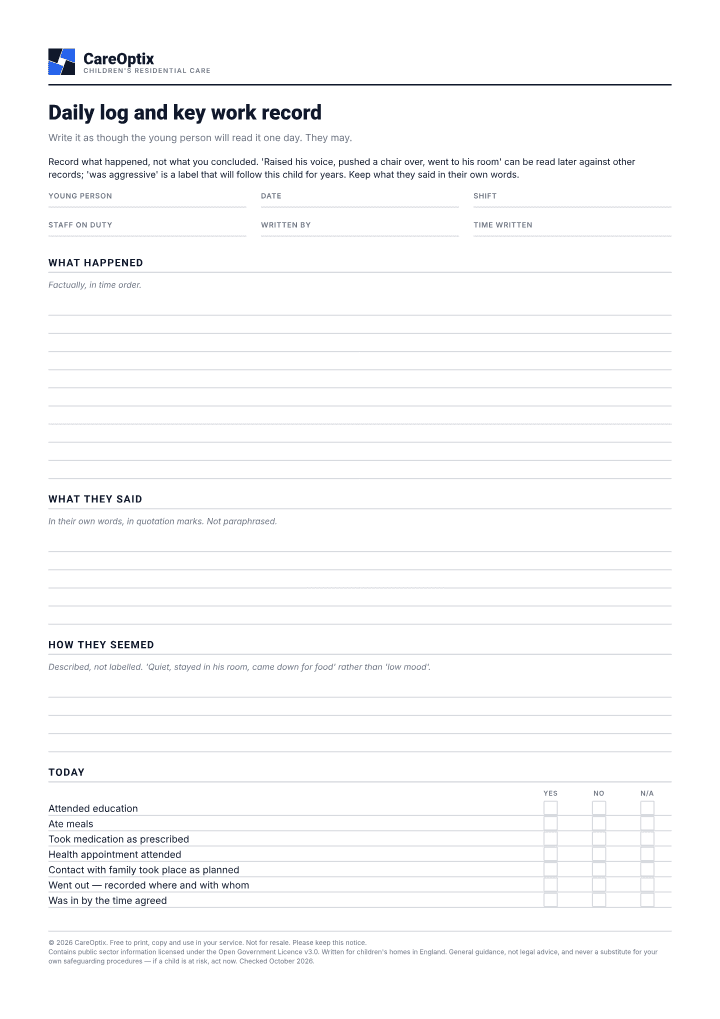
What is on the sheet
- Date, shift, who was on, and which child the entry is about
- What actually happened, factually, in time order
- What the child said, in their words, kept separate from what staff concluded
- How the child seemed, described rather than labelled
- Anything that needs following up, and who is doing it
- Key work sessions: what was worked on, what the child thought, and what was agreed
Why this record matters
A daily log is read by inspectors, by social workers, by courts and — if they ask — by the child it is about. Writing every entry as though the young person will read it one day is both the right thing to do and the quickest way to raise the standard of recording in a home.
Separating observation from interpretation is the discipline that matters most. 'Was aggressive' is a conclusion; 'raised his voice, pushed a chair over, went to his room' is what happened, and only the second can be read later against anything else. Labels pile up in a file and follow a child for years.
The child's own words are given their own place for the same reason. A log that paraphrases everything a young person says has replaced them with staff voices, and the sentence that turns out to matter — months later, in a safeguarding enquiry — is almost always one somebody said in their own words.
Key work is recorded on the same sheet because it is part of the same relationship, not an administrative extra. What was worked on, whether the young person thought it was useful, and what was agreed is a far stronger record than a session that happened.
Use it with
- Placement plan templateA printable placement plan — how this home will meet this child's needs day to day, written with the child rather than about them.
- Wishes and feelings recordA printable record of what a child has said they want — asked properly, recorded in their words, and followed up so they can see what happened.
- Safeguarding concern recordA printable record of a safeguarding concern — what was seen or said, what was done about it immediately, and who was told.
- Incident recordA printable incident record — what led up to it, what happened, what the child said afterwards, and what the home is going to do differently.
Read more on this
© 2026 CareOptix. Free to print, copy and use in your service. Not for resale. Please keep this notice.
Contains public sector information licensed under the Open Government Licence v3.0. Written for children's homes in England. General guidance, not legal advice, and never a substitute for your own safeguarding procedures — if a child is at risk, act now. Checked October 2026.