Safeguarding concern record. A printable record of a safeguarding concern — what was seen or said, what was done about it immediately, and who was told.
This is a record, not a procedure. Your home's safeguarding policy and your local safeguarding partnership's procedures say who to contact and in what order, and they take precedence over anything here — if a child is at risk now, act on them and complete this afterwards. Neither this sheet nor CareOptix decides whether something is a safeguarding matter; what the platform does is make sure the record exists, reaches the DSL immediately, and is not sitting in a folder.
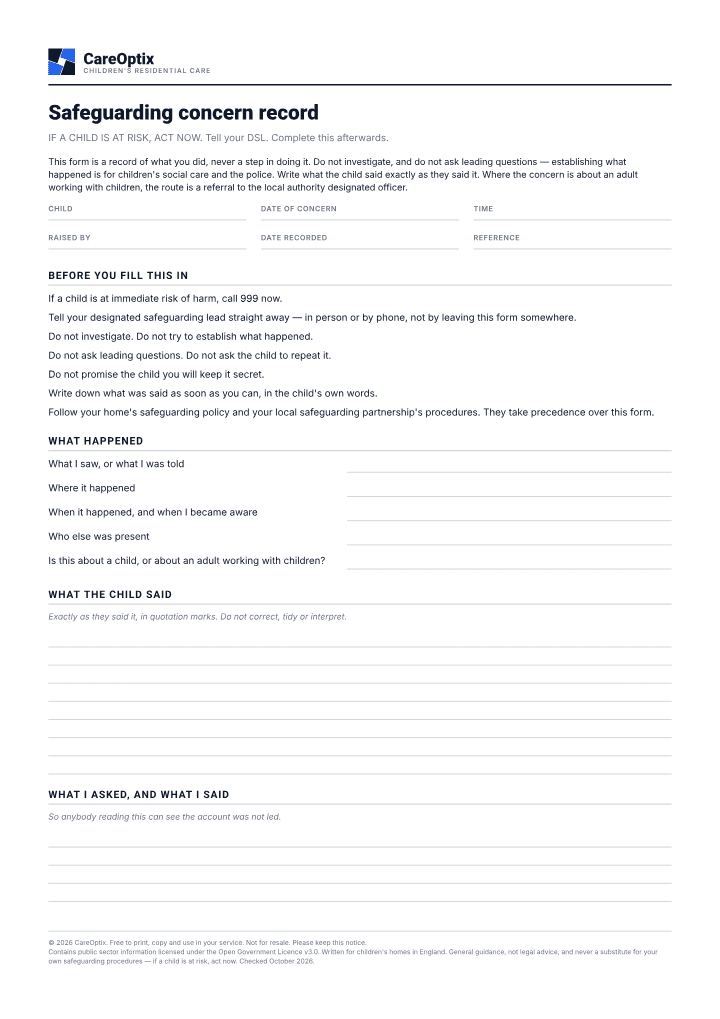
What is on the sheet
- A prominent instruction to act first and complete the form afterwards
- Who raised the concern, when, and what they saw or were told
- The child's own words, recorded exactly and without asking leading questions
- Immediate action taken to make the child safe
- Who was told, when, and what they said to do — DSL, children's social care, police, LADO where it concerns an adult
- What the child was told about what happens next, and the ongoing actions with owners
Why this record matters
The most important thing on this form is printed above the first field: if a child is at risk, act now and write this afterwards. A form is a record of a response, never a step in it, and a staff member who believes they must complete paperwork before telling somebody has been failed by the form.
Recording the child's exact words is the part that has evidential consequences. A disclosure written down as the child said it can be used; one paraphrased into professional language can be challenged, and a child asked leading questions to clarify it may have had their account contaminated before anybody qualified has heard it.
So the form asks what was said and what was asked, and says plainly not to investigate. Establishing what happened is the job of children's social care and the police. The home's job is to make the child safe, record accurately, and tell the right people straight away.
Where a concern is about an adult working with children, the route is different and the form says so. That is a referral to the local authority designated officer, and it is the route most often missed because it feels disproportionate — which is precisely why it exists.
Use it with
- Incident recordA printable incident record — what led up to it, what happened, what the child said afterwards, and what the home is going to do differently.
- Daily log and key work recordA printable daily log and key work session record — what happened, what the child said and did, and what it means, written so a child could read it.
- Missing from care recordA printable record for a child missing or away from the home without agreement — what was done, who was told, and what the child said when they came back.
- Staff induction checklistA printable induction checklist for somebody starting in a children's home — the children, the policies that matter on the first night, and what they must not do until they are trained.
Read more on this
© 2026 CareOptix. Free to print, copy and use in your service. Not for resale. Please keep this notice.
Contains public sector information licensed under the Open Government Licence v3.0. Written for children's homes in England. General guidance, not legal advice, and never a substitute for your own safeguarding procedures — if a child is at risk, act now. Checked October 2026.