Regulation 44 visit record. A printable structure for an independent visitor's report — what they looked at, who they spoke to, what the children said, and whether the home is meeting the standards.
This is a structure for a report, not the requirement. Who may carry out a Regulation 44 visit, what it must cover, how often it happens and who the report goes to come from the Children's Homes (England) Regulations 2015 — and the visitor's independence is the whole point of the exercise, which no template supplies. Neither this sheet nor CareOptix makes anybody independent; what the platform does is hold the reports, track the recommendations and show whether they were actually closed.
What is on the sheet
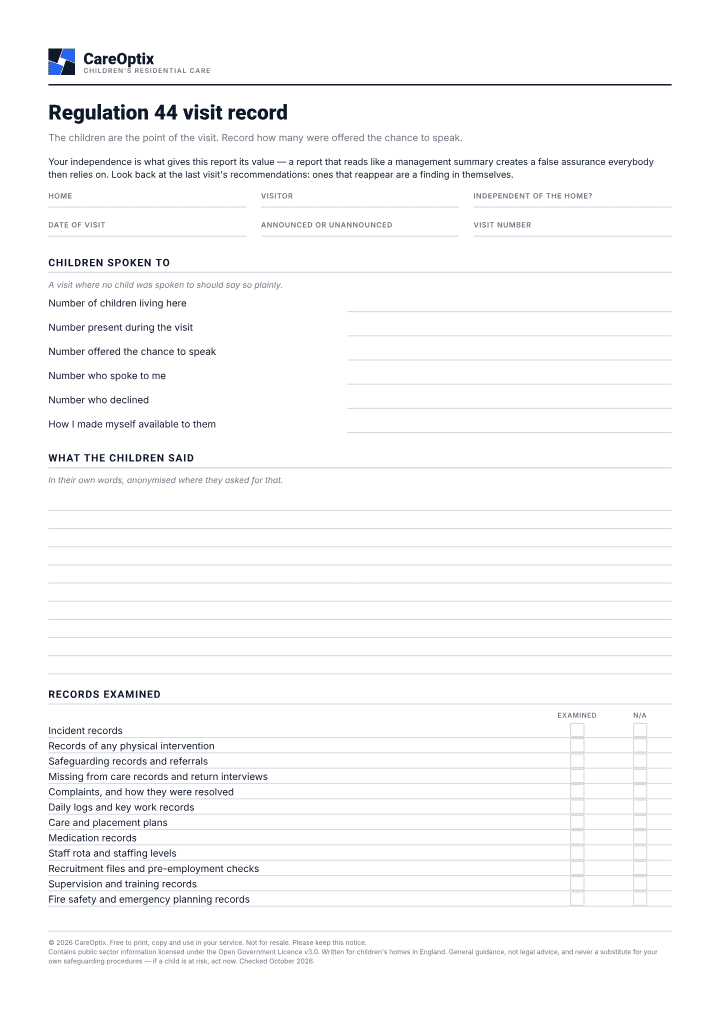
- The home, the visitor, the date, and whether the visit was announced
- Children spoken to, how many were offered the chance, and whether anybody declined
- What the children said, in their own words, about living there
- Records examined — incidents, complaints, safeguarding, medication, staffing and recruitment
- The visitor's view on whether children are safeguarded and whether the home is meeting its standards
- Recommendations with owners, the registered manager's response, and progress against the last visit
Why this record matters
A Regulation 44 visit is an independent check on whether children in a home are safe and well cared for, and its value depends entirely on the visitor actually being independent. A report that reads like a management summary, with recommendations the manager would have made anyway, is worse than none because it creates a false assurance everybody relies on.
The children are the point of the visit, and the structure of this form reflects that: how many were offered the chance to speak, how many did, what they said in their own words, and whether anybody declined. A visit where no child was spoken to is not a Regulation 44 visit in any meaningful sense, and the report should say so plainly.
Progress against the last visit is the section most often missing and the one that shows whether the process does anything. Recommendations that reappear visit after visit are a finding in themselves, and a report that does not look back cannot surface that.
The visitor's conclusion is a judgement about whether children are protected and whether the home is meeting its standards. This form gives it structure; who is independent enough to make it, what the visit must cover and how often it happens come from the Regulations, not from here.
Use it with
- Staff supervision recordA printable supervision record — the children, the practice, the person doing the job, and what was actually agreed rather than discussed.
- Wishes and feelings recordA printable record of what a child has said they want — asked properly, recorded in their words, and followed up so they can see what happened.
- Incident recordA printable incident record — what led up to it, what happened, what the child said afterwards, and what the home is going to do differently.
- Safeguarding concern recordA printable record of a safeguarding concern — what was seen or said, what was done about it immediately, and who was told.
Read more on this
© 2026 CareOptix. Free to print, copy and use in your service. Not for resale. Please keep this notice.
Contains public sector information licensed under the Open Government Licence v3.0. Written for children's homes in England. General guidance, not legal advice, and never a substitute for your own safeguarding procedures — if a child is at risk, act now. Checked October 2026.